How to Regain Confidence and Silence Your Inner Critic
Introduction
If you’re trying to regain confidence as a stay-at-home mom, you might not have lost it completely. You may have just lost it in certain rooms.
I realized this during my daughter’s school dance program.
Ten mothers were invited to perform, and I said yes immediately. I love dancing. When the music started, I didn’t hesitate. I moved freely, smiled confidently, and didn’t compare myself to anyone.
On that stage, I felt strong.
But after the performance, parents were asked to sit together for a short meeting. Conversations began. Many spoke fluent, effortless English, discussing work and daily responsibilities.
And suddenly, my confidence shifted.
My mind filled with “what ifs.”
⇒What if I say something wrong?
⇒ What if I get stuck mid-sentence?
⇒ What if my English isn’t good enough?
Just minutes earlier, I had performed confidently in front of the same people.
So what changed?
That day I understood something important: my confidence was conditional. I felt strong when I was good at something. I felt small when I believed others were better than me in that space.
The truth is, I love being a stay-at-home mom. I believe these early years matter deeply, and I’m proud of the work I do at home.
But confidence built on comparison is fragile.
And if you’ve ever felt capable in one area but invisible in another, this guide is for you.
Because real confidence isn’t about being the best in the room.
It’s about knowing your value in any room — and that can be rebuilt.
Understanding Why Confidence Often Fades After Motherhood
Before we try to regain confidence, we need to understand something important:
Nothing is wrong with you.
Motherhood did not reduce your capability, intelligence, or worth.
⇒ But it did change your environment.
⇒ It changed your identity.
⇒ And it changed how the world responds to you.
And those changes quietly affect confidence.
Let’s look at how.

Understanding that your confidence hasn’t disappeared—it has simply evolved.
The Identity Shift No One Prepares You For
Before becoming a mother, you may have:
- Worked in a company
- Built a business
- Created something of your own
- Achieved personal goals
Your growth was visible.
⇒ People appreciated you.
⇒ Your achievements were measurable.
⇒ After motherhood, the work changes.
Now you:
- Raise children
- Manage a home
- Handle emotional breakdowns
- Show up even on days you feel exhausted.
But this work is rarely celebrated the same way.
⇒ There are no promotions.
⇒ No performance reviews.
⇒ No public appreciation.
Slowly, a silent thought may enter:
“Maybe I’m not as worthy as before.”
But the truth is — you didn’t lose your ability. The label changed. The visibility changed. The validation changed.
And when identity shifts without recognition, confidence feels shaken.
Financial Dependence and Subtle Self-Doubt
This is something I personally experienced.
My husband has never stopped me from spending money. In fact, he encourages me to buy what I need. But still, when I want something for myself, I sometimes feel guilty.
A small voice inside says the following:
- “He worked hard for this.”
- “I’m not earning.”
- “Maybe I shouldn’t spend on myself.”
The guilt doesn’t come from him. It comes from within.
Over time, I understood that this feeling is shaped by society. We are taught—directly or indirectly—that earning money equals contribution. So when we don’t earn, we begin to question our value, even if we are managing the entire household. And until we challenge that belief, it becomes harder to regain confidence.
Sometimes I would even stop myself from complaining about being tired, thinking, “He is working outside. I should adjust.”
But this is work:
- Running a home
- Raising children
- Emotional and mental planning
Still, because there is no salary attached to it, the mind quietly reduces its importance. And that subtle thought can slowly reduce confidence— making it harder to regain confidence over time if it goes unchallenged.
Social Isolation and Reduced Adult Interaction
One of my friends was once a bank assistant manager. Another ran her own business.
Before motherhood, they:
- Interacted with people daily.
- Solved problems.
- Made decisions.
- Were consulted for advice.
After becoming mothers, things changed.
The routine became:
- Wake up.
- Prepare breakfast.
- Get kids ready.
- School chores.
- Evening snacks.
- Study time.
- Dinner.
- Bedtime.
The same cycle. Every day.
One of them once told me,
“I feel like I’m stuck in a loop. I wasn’t like this before.”
When an old colleague called her for advice, she felt hesitant. She questioned herself. She felt like she had “lost” the sharpness she once had.
But she didn’t lose intelligence.
She lost reinforcement.
Confidence grows through interaction, feedback, and recognition. When adult conversations reduce and your world becomes smaller, your self-perception can shrink too.
Not because you became less—
But because you became isolated.
The Invisible Mental Load
This is something I didn’t understand before becoming a mother.
Even when I’m cooking, my mind is not just cooking. It is calculating.
I’m thinking about:
- What time the food will be ready?
- School schedules
- Homework
- Doctor appointments
- Monthly expenses
- How to respond calmly if my child throws a tantrum
My body may be in the kitchen, but my mind is handling ten things at once.
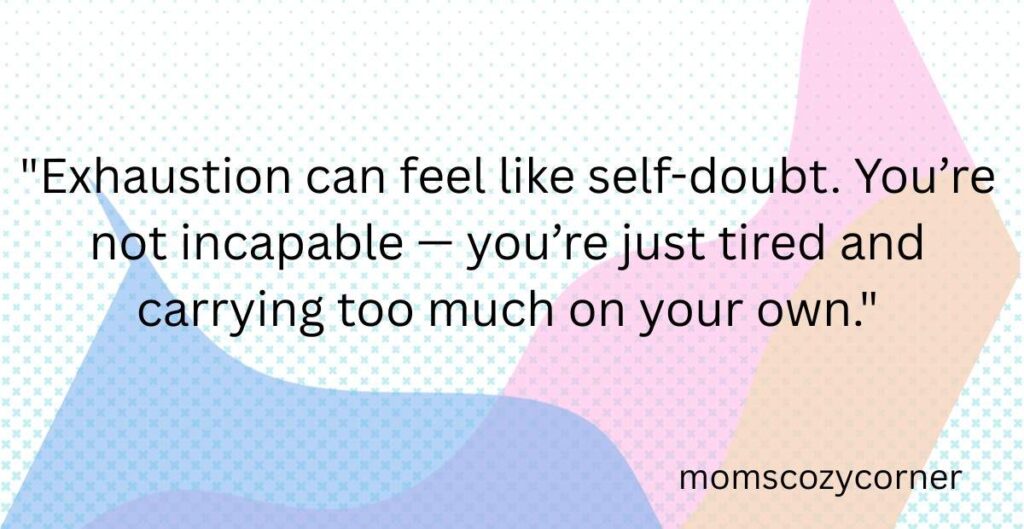
A gentle reminder for the days when the mental load feels too heavy.
Some days, the constant thinking makes me deeply exhausted. And on those days, even a small mistake feels heavy. If something goes wrong, I question myself:
⇒“Why can’t I handle this better?”
⇒“Am I even doing this properly?”
But later I realized — it’s not incapability. It’s mental overload.
When your brain never truly rests, your confidence naturally drops. Not because you are weak, but because you are tired.
And exhaustion often disguises itself as self-doubt.
The Truth Behind It All
Understanding this is powerful.
Your confidence didn’t disappear because you are incapable.
It faded because:
- Your identity shifted.
- Your contribution became invisible.
- Society values income over caregiving.
- Your adult interaction reduced.
- Your mental load increased.
When you understand the real reasons, you stop blaming yourself.
And when self-blame stops, rebuilding confidence becomes possible.
Because the woman you were before motherhood?
She is still there.
She just needs space, validation, and recognition—starting from you.
The Hidden Signs You’ve Lost Confidence
Losing confidence doesn’t happen overnight.
It fades slowly—through small behaviors that start feeling normal. We think we’re just adjusting, being polite, or avoiding drama.
But certain patterns quietly indicate that your confidence is decreasing — and recognizing them early can help you regain confidence before it slips further.

The physical weight of the mental load, fear, and constant self-comparison.
Over-Apologizing and People-Pleasing
My daughter’s classmate’s mom once shared something honest with me.
- She noticed a pattern in herself:
- She apologizes even when she hasn’t done anything wrong.
- She adjusts quickly to avoid conflict.
- She tries to keep everyone comfortable.
Even when she knows she is right, she says sorry first—because it feels safer than standing firm.
Then she admitted something powerful:
“This is not patience. This is my lack of confidence.”
What worried her most was her daughter. She didn’t want her child to grow up watching her:
- Constantly adjusting
- Constantly pleasing
- Silently hurting
That’s when she understood—over-apologizing isn’t always kindness. Sometimes, it indicates that your confidence is decreasing because you no longer trust your own voice.
Indecisiveness and Fear of Being Wrong
Another friend lives in a joint family due to their family business. Moving out would affect them financially, so it’s a serious decision.
But she often feels uncertain about the environment her children are growing up in. Her concerns are real—yet she feels stuck.
Not because she isn’t capable.
But because she keeps doubting her own judgment.
She wonders:
- “Am I overthinking?”
- “What if I’m wrong?”
- “What if I regret it?”
Even when her instincts are clear, fear overrides them.
This isn’t a lack of intelligence. It’s a lack of self-trust. And when you constantly second-guess yourself, it indicates that your confidence is decreasing — making it harder to regain confidence over time..
Avoiding Social Situations
Have you ever noticed yourself avoiding gatherings you once enjoyed?
Maybe:
- School events
- Weddings
- Parties
- Family functions
Not because you’re busy—but because you don’t want to answer questions.
You don’t want to explain your life choices.
You don’t feel ready to respond confidently.
So avoiding feels safer than facing.
But withdrawing from social situations, especially when it comes from fear, indicates that your confidence is decreasing. Isolation may feel protective in the moment—but it quietly reinforces self-doubt.
Constant Self-Comparison
This one is dangerous.
You compare:
- Your cooking with another mom’s
- Your parenting with someone on social media
- Your English with someone who speaks fluently
- Your dressing, your lifestyle, your progress
Not occasionally — but constantly.
When comparison becomes a daily habit, you slowly convince yourself that you are not enough.
And constant comparison clearly indicates that your confidence is shrinking — because instead of recognizing your own growth, you measure yourself only against others.
The good news?
These are signs — not permanent labels.
Once you recognize them, you can begin rebuilding your confidence with awareness instead of self-blame — and slowly regain confidence in a healthier way.
Why You No Longer Feel Like Yourself
After noticing the signs—the over-apologizing, the self-doubt, the comparison—I had to ask myself a harder question about how to regain confidence:
What’s really happening underneath all this?
Confidence doesn’t just disappear. There are psychological reasons behind why it starts to fade. And when I looked honestly at my own life, three patterns stood out.

When you push your feelings down again and again, you begin to feel disconnected from yourself.
Emotional Suppression in Daily Motherhood
Motherhood changed my priorities. That part is natural. I don’t feel guilty for putting my family first.
But I did notice something.
- I stay calm when I feel angry.
- I respond gently when I’m exhausted.
- I push through even when I’m overwhelmed.
That’s emotional regulation, and it’s necessary.
But when I constantly push my feelings aside without ever processing them, regulation slowly turns into suppression.
And suppression creates numbness.
I started functioning well… but feeling less. Less reactive. Less expressive. Less like myself.
That quiet emotional disconnection became one of the deeper psychological reasons my confidence felt weaker. When you’re not fully connected to your emotions, you slowly stop trusting your own inner voice— and it becomes harder to regain confidence.
Losing Touch With Personal Interests
I love drawing. I always have.
Before kids, I used to try:
- New styles
- New techniques
- Little DIY projects—just for fun
Now?
I tell myself I’ll start again “when things settle.”
I walk past art supplies and feel a quiet longing. I wonder if I’ve lost my touch.
It’s not just about a hobby.
It’s about identity.
When I stopped doing something that made me feel creative and capable, I lost evidence of that version of myself. And confidence grows when you experience yourself as expressive, evolving, and skilled — which is exactly how you begin to regain confidence.
When that expression disappears, even temporarily, confidence softens with it.
Not because I became incapable.
But because I stopped seeing myself beyond my responsibilities.
Living in Survival Mode
Most days feel like survival mode.
- Finish the tasks.
- Keep the peace.
- Support the kids academically and emotionally.
- Avoid unnecessary conflict.
Sometimes it feels like living on an island where every day brings new wind to push against.
I focus on getting through the day peacefully — even if not happily.
And in that constant “handle what’s next” mindset, life can start to feel mechanical. Productive, but disconnected. Responsible, but emotionally distant.
That survival mode doesn’t mean I’ve changed as a person.
It just means I’ve been operating on autopilot for too long.
And here’s the truth I’m slowly understanding:
I didn’t lose myself.
Motherhood didn’t erase me.
The confidence I’m looking for isn’t gone.
It’s still there — just buried under responsibility, routine, and self-neglect.
And once I see that clearly, it feels possible to reconnect with it again.
The Psychological Impact of Long-Term Insecurity
Insecurity isn’t like anger or sadness — something that shows up and then fades.
When you repeatedly believe that you’re “not good enough,” it doesn’t stay a simple thought. It becomes a pattern. And patterns, over time, begin to shape the brain.
You can rewire your brain in helpful ways.
You can also rewire it in harmful ways.
If the message running in your mind is:
- “I’m not capable.”
- “I always mess things up.”
- “I’m not enough.”
That message slowly becomes your inner dialogue. And once that dialogue feels familiar, your brain starts treating it like truth.
Here’s what that often looks like beneath the surface.

Long-term insecurity often turns into quiet self-blame.
The Inner Critic Gets Louder
At first, it’s occasional self-doubt. Over time, it becomes automatic self-blame.
- If your child doesn’t perform well, you think: “I didn’t teach her properly.”
- If someone seems distant, you assume: “I must have done something wrong.”
- If something goes off track, your first response is: “This is my fault.”
Instead of looking at situations objectively, your mind filters everything through one belief — I’m the problem.
Psychologically, repetition strengthens neural pathways. The more often you blame yourself, the more natural it feels. Eventually, your inner critic doesn’t sound negative anymore. It sounds accurate, which makes it harder to regain confidence.
And that’s when confidence starts shrinking quietly.
Overthinking Everything
Long-term insecurity often turns into constant mental replay.
- You revisit small arguments again and again.
- You replay moments you felt you weren’t patient enough.
- You sit in guilt, trying to “analyze it properly.”
It feels like you’re solving something.
But most of the time, overthinking is your nervous system trying to feel safe.
“If I think about this enough, I won’t make another mistake.”
The problem is, instead of building clarity, it reduces self-trust. The more you question yourself, the less confident you feel making decisions.
Overthinking isn’t about intelligence.
It’s about a mind that doesn’t feel secure enough to trust itself.
If you find yourself stuck in constant mental replay, you may want to read my in-depth guide on how to stop overthinking everything and find peace in life, because calming the mind is a powerful step toward rebuilding confidence.
Sensitivity to Criticism
When someone gives advice or genuine feedback, it can feel heavier than it should.
- You don’t hear guidance — you hear confirmation.
- You think: “See? I knew I wasn’t enough.”
You absorb feedback as proof of your existing self-doubt.
Instead of using criticism to improve, your brain connects it to old beliefs.
This happens because your mind links present comments to past insecurities. And since your inner voice has been repeating the same doubts, your brain reacts automatically.
It’s not weakness.
It’s a trained pattern.
Confidence and Brain Patterns
Here’s the empowering part.
The brain changes based on repetition. This is called neuroplasticity.
If you repeatedly tell yourself:
- “Motherhood changed me for the worse.”
- “I’m not who I used to be.”
- “I’m not good enough.”
Your brain strengthens that belief.
But the opposite is also true.
Confidence is a pattern. And patterns can be rebuilt.
Believing you’ve changed doesn’t mean you’re gone. It may just mean your self-doubt has been louder than your self-trust for a while.
You are still you.
The confidence you think is gone isn’t destroyed — it’s just buried under repeated doubt.
And with new repetition, new thoughts, and small consistent self-trust, your brain can rewire again — this time in your favor.
If you want practical ways to shift your thinking patterns, you can also read my article on how to be a more positive person, because the way you consistently speak to yourself directly affects how you regain confidence.
How to Rebuild Confidence as a Stay-at-Home Mom (Without Guilt or Pressure)
You didn’t lose yourself. You stopped prioritizing yourself. And that’s very different. Rebuilding confidence doesn’t require dramatic change. It happens in small, steady shifts. Let’s make this simple and doable.

Confidence is built in the small, quiet moments—one micro-ritual at a time.
1. Micro-Rituals That Restore Your Identity
This isn’t about adding more to your to-do list. It’s about claiming 10–15 minutes a day that belong only to you.
- Not scrolling.
- Not cleaning.
- Not catching up on chores.
Just you.
Tiny actions send a powerful signal to your brain:
I still matter.
I noticed this in my own life — if I have one hour to cook, I take one hour. If I only have 45 minutes, I still finish in 45. The work stretches to the time we give it.
So protect 10–15 minutes. Simple ideas:
- Drink a hot cup of coffee alone
- Stretch or move your body for 10 minutes
- Sit in silence and breathe
- Journal one page
- Step outside for fresh air
It’s not about escaping your life. It’s about staying connected to yourself inside it.
Miss a day?
Begin again. Confidence grows because you return — not because you’re perfect, and every time you return, you begin to regain confidence.
2. Reclaim Old Interests in Small, Realistic Ways
You don’t need to become who you were before motherhood. But you can reconnect with pieces of her.
Start small.
If you love gardening, begin with one sapling. Care for it. Watch it grow. Three months later, maybe you have ten plants.
That’s how confidence grows too.
Other simple ways:
- Read one book in three months
- Dance to one song in the kitchen
- Sketch once a week
- Write one paragraph a day
- Try one new recipe a month
Maybe you used to finish a book in a week. Now it takes months. That doesn’t mean you failed. It means your season changed.
This isn’t about productivity.
It’s about remembering:
I still have passions.
I still have depth.
3. Setting Personal Goals Beyond Motherhood (Without Pressure)
Managing a home is a role.
It is not your entire identity.
Personal goals don’t have to mean earning money or adding stress. They can be internal.
Many stay-at-home moms struggle with guilt — especially around money.
But you and your husband are a team playing different roles.
He contributes financially.
You contribute emotionally, mentally, physically, daily.
Both matter.
You are not “spending his money.”
You are part of a shared life.
Gentle personal goals might look like:
- Working on emotional regulation
- Taking care of your mental health
- Walking three times a week
- Becoming more confident managing household finances
- Practicing calmer responses
These are alignment goals — not achievement goals.
Your mental health isn’t selfish.
It’s foundational.
4. Letting Go of the “Perfect Mom” Standard
Trying to be a perfect mom quietly destroys confidence.
You won’t respond calmly all the time. You won’t do everything right.
You are human.
You are learning.
Instead of being perfect, be present.
When your child has a tantrum:
- Stay with them
- Help them regulate emotions
- Apologize if you shout
- Remind them your love doesn’t change
“I’m sorry” teaches repair.
Presence teaches safety.
Perfection says: “I must never fail.”
Presence says: “I stay, even when I mess up.”
Choose presence.
Start This Week
- Choose one 10–15 minute ritual
- Restart one old interest
- Set one gentle personal goal Replace “perfect” with “present”
- Tell yourself: I am learning. I am enough.
You didn’t lose yourself. You stopped choosing yourself.
And when you begin again — even in small ways — confidence returns.
Gradually.
Steadily.
Honestly.
And this time, it’s built on awareness — not pressure.
Rebuilding Self-Belief After a Major Setback
A major setback can quietly damage your confidence, making it harder to regain confidence if you don’t address it.
Maybe:
- You quit your job to care for your family.
- Finances feel tight.
- A relationship misunderstanding hurt you.
- You paused your personal goals for a long time.
Slowly, you begin questioning yourself.
- “Did my decisions bring me here?”
- “Am I still capable like before?”
You hesitate more. You overthink simple choices. You start believing something is wrong with you.
But self-belief can be rebuilt — step by step.

Restoring belief starts with quiet moments of self-connection.
Restoring Broken Self-Trust
After a setback, the biggest loss isn’t external.
It’s internal. You stop trusting yourself.
Don’t begin with big promises like, “I’ll completely change from tomorrow.” That usually leads to disappointment.
- Start small.
- Cook one healthy meal today.
- Avoid sugary snacks in the morning.
- Finish one small task fully.
- Take a 10-minute walk.
When you keep even one small promise, your brain gathers evidence:
⇒ “I said I would do this. And I did.”
Confidence grows from repeated proof — not dramatic plans.
Focus on progress, not perfection.
Practicing Positive Self-Talk Effectively
Positive self-talk isn’t lying to yourself.
A friend once told me, “If I weigh 90 kilos, how can I stand in front of the mirror and say I’m fit? That’s not true.”
She was right.
Forced positivity feels fake.
Instead of unrealistic replacement, use realistic reframing.
Instead of:
“I’m unhealthy and I always fail.”
Try:
“I haven’t found a routine that works for me yet.”
Instead of:
“I always mess things up.”
Try:
“This didn’t go well. I can handle it better next time.”
I use this in parenting too. If I shout, I don’t call myself a bad mom. I tell myself, “Next time, I’ll respond more calmly.”
Reframing keeps you growing. It feels honest — and your brain accepts honesty, which helps you regain confidence more steadily.
How Body Language Affects Confidence
I’ve seen this in my own life.
When I’m on stage dancing, I stand tall and feel strong.
But once, sitting in a room full of other moms, I avoided eye contact, slouched slightly, and smiled nervously.
Same person. Different posture. Different confidence.
Try:
- Standing straight
- Opening your shoulders
- Holding gentle eye contact
Your body can influence your mindset.
Posture sends signals — not just to others, but to your own brain.
The Fastest Small Wins to Boost Confidence
Small wins create momentum.
I used to overwhelm my daughter with 30 spelling words a day. It frustrated both of us.
Then I reduced it to five words a day.
She improved. I felt successful.
Small completions build belief.
Try this:
- Finish one avoided task
- Learn one small skill
- Speak up once
Confidence returns through consistent small proof — not pressure.
Step by step.
Breaking the Comparison Trap
Comparison didn’t start yesterday.
It started in childhood.
We were compared
- To siblings.
- To neighbors’ kids.
- To classmates.
At first, others compared us.
Then we learned to compare ourselves.
And over time, it quietly shaped our confidence.
The problem is — comparison rarely makes you feel stronger. It usually makes you feel smaller.

Don’t compare your “behind-the-scenes” to someone else’s highlight reel.
Social Media Illusions
Social media makes this worse.
You scroll and see:
- A mom doing skincare at 5 a.m..
- Maintaining her physique.
- Managing her career.
- Consoling her toddler calmly.
- Posting happy family pictures.
It looks effortless.
But what you don’t see:
- The financial stress
- The messy house outside the frame
- The emotional breakdowns
- The exhaustion
One of my close friends once told me, “I uninstalled Instagram. Every time I saw fit moms with perfect homes and well-behaved toddlers, I felt small.”
But the solution isn’t always deleting social media.
It’s understanding that you’re seeing a highlight reel — not the whole story.
Don’t measure your confidence through someone else’s edited moments.
Comparing Yourself to Working Moms
As a stay-at-home mom, it’s easy to compare yourself to working moms – and constant comparison can quietly delay your ability to regain confidence.
You may think:
- “She earns money, so she must be more confident.”
- “She manages career and home. Why can’t I?”
But this isn’t about superior or inferior.
It’s about different roles.
She carries one kind of responsibility.
You carry another.
Income does not define value.
You contribute to your family in your way. She contributes in hers.
Comparison here isn’t even logical — because the roles are different, not better or worse.
Turning Comparison Into Self-Reflection
As humans, we naturally compare.
If you can’t stop it, redirect it.
When you admire a working mom’s energy, don’t assume you need her career.
Ask yourself:
- Is it her confidence I admire?
- Her discipline?
- Her clarity?
You can build that energy in your own role.
Let comparison show you what you value — not what you lack.
Gratitude Rewiring Exercise
Gratitude changes perspective.
Once, while walking, I saw someone struggling to get from one place to another. I felt thankful that I had a vehicle.
Another time, I saw a husband slap his wife in public. I felt deeply sorry for her — and grateful that my husband would never treat me that way.
These moments reminded me:
There is always something to be thankful for.
Instead of focusing only on what’s missing, notice what’s already good.
Comparison shrinks your world.
Gratitude expands it.
And when your perspective expands, your confidence begins to rise again — gently, steadily.
Learning to Treat Yourself With Compassion
I’ve seen so many stay-at-home moms do everything with patience.
They:
- Take care of elders
- Manage the home
- Listen calmly to other people’s problems
- Comfort everyone around them
But when it comes to themselves?
The kindness disappears.
⇒Instead of compassion, there’s self-blame.
⇒ Instead of understanding, there’s criticism.
And over time, constant self-blaming quietly destroys confidence.
You give grace to everyone else — but deny it to yourself.
When you begin to treat yourself with compassion — not excuses, but understanding — your confidence naturally grows. Because you stop attacking yourself and start supporting yourself.
Speaking to Yourself Like a Friend
Think about this.
If your friend came to you and said, “I messed up. I did something terribly wrong,” what would you say?
You’d probably respond with:
- “It happens. You’re human.”
- “Don’t judge yourself by one mistake.”
- “Remember all the good things you’ve done.”
You would remind her of her strengths.
But when you make a mistake?
The inner voice changes:
- “I messed up.”
- “I’m not good enough.”
- “I always do this.”
Why the double standard?
Self-compassion means becoming your own friend.
It doesn’t mean exaggerating praise or pretending everything is perfect.
It means being real — and fair.
Ask yourself: If my friend were in this situation, what would I tell her?
Then say that to yourself. That’s how you begin to regain confidence in a healthier, more honest way.
Allowing Imperfection
The pressure to be perfect is exhausting.
Perfect mom.
Perfect meals.
Perfect body.
Perfect emotional control.
But perfection isn’t realistic.
You will:
- Get angry sometimes
- Feel tired
- Make wrong decisions
- Lose patience
That doesn’t mean you are failing.
It means you are human.
Imperfection is not something to hide from — it’s something to grow through.
Don’t dig yourself into guilt. Use mistakes as learning moments.
Growth builds confidence. Perfection anxiety destroys it.
Modeling Self-Respect for Your Children
Your children are always watching.
They notice:
- How you talk about your body
- How you talk about your career
- How you respond to mistakes
- Whether you stand up for yourself
If you constantly criticize yourself, they learn that pattern.
If you:
- Admit mistakes calmly
- Speak kindly about yourself
- Stand up when you’re not wrong
- Express feelings in a healthy way
They learn self-respect.
And that’s powerful.
Because love doesn’t stop with loving others.
It includes loving yourself too.
Confidence shrinks under constant criticism.
But when you understand your feelings, adjust your approach, and treat yourself with compassion — you’ll slowly regain confidence and feel it rise again.
A 30-Day Confidence Reset Plan for Stay-at-Home Moms
Confidence doesn’t usually disappear overnight.
It fades slowly — through comparison, self-criticism, exhaustion, and putting yourself last, which is why learning how to regain confidence takes awareness and intention.
But the good news?
It can be rebuilt — intentionally.
This 30-day reset isn’t about becoming a “new you.”
It’s about reconnecting with the version of you that already exists.
Let’s break it down week by week.
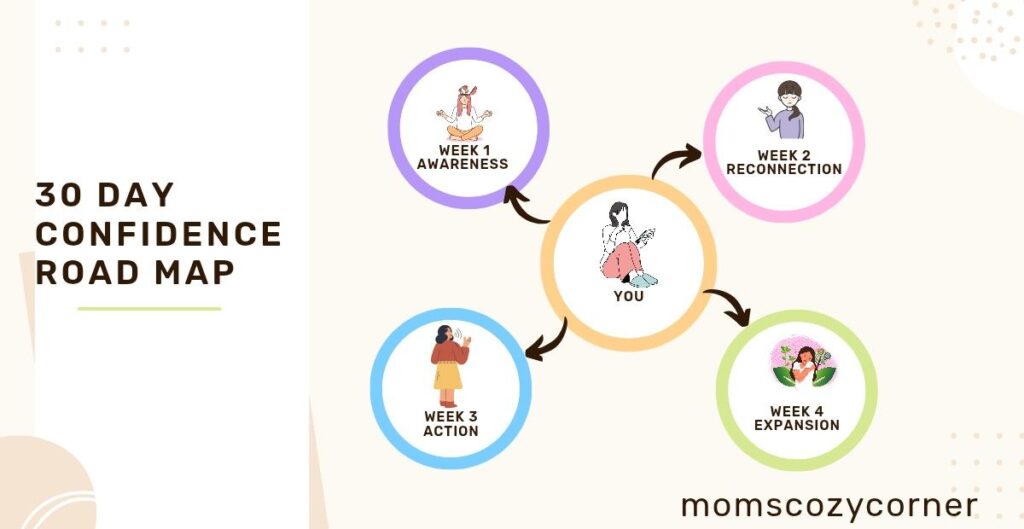
Your visual guide to reclaiming confidence over the next 30 days.
Week 1: Awareness
You can’t rebuild what you don’t understand.
This week is about observing — not judging.
Checklist:
- Notice when you criticize yourself.
- Pay attention to comparison triggers (social media? meetings? family gatherings?).
- Write down three situations where you felt small or insecure.
- Identify your inner voice — what phrases does it repeat?
- Spend 5 minutes daily journaling how you actually feel.
The goal isn’t to fix anything yet.
It’s to become aware.
Awareness reduces emotional autopilot.
Week 2: Reconnection
Now that you see the patterns, it’s time to reconnect with yourself.
Confidence grows when you remember who you are — beyond roles, and that reconnection helps you regain confidence from within.
Checklist:
- List 10 strengths that have nothing to do with income.
- Revisit a hobby you once loved (even 15 minutes counts).
- Stand tall and practice open body posture daily.
- Replace one negative self-statement with a neutral or kind one.
- Schedule one small activity just for yourself.
This week is about identity.
Not just “mom.”
Not just “wife.”
You.
Week 3: Action
Confidence grows through movement.
Not big achievements — small, consistent action.
Checklist:
- Do one small thing you’ve been postponing (a phone call, a message, organizing one drawer).
- Speak your opinion once where you’d normally stay silent.
- Wear something you like instead of what’s just “easy.”
- Start that task you’ve been overthinking — even for 10 minutes.
- Say “no” once without over-explaining.
These are tiny courage reps.
Action is the antidote to overthinking. Your brain can’t replay a mistake if it’s too busy doing the next small thing.
Week 4: Expansion
Now you’re not just rebuilding confidence — you’re expanding it.
Checklist:
- Share your thoughts openly with someone you trust.
- Set a boundary you’ve been avoiding.
- Reduce one comparison habit.
- Teach your child something about self-respect.
- Reflect on how you feel compared to Day 1.
Notice the shift.
Confidence isn’t loud.
It’s steady.
By the end of 30 days, you may not feel perfect.
But you’ll feel stronger.
Because confidence doesn’t come from doing everything.
It comes from showing up for yourself — consistently, and that consistency is what helps you regain confidence over time.

Sometimes, the bravest thing you can do is ask for a professional hand to hold.
When Low Confidence May Need Professional Support
Most of the time, low confidence is connected to mindset.
And yes — working on self-talk, gratitude, posture, and small action steps can truly help you regain confidence.
But sometimes…
It goes deeper than that.
If you’ve tried everything and still feel heavy inside — still feel stuck — it may not just be a confidence issue.
There are certain signs you shouldn’t ignore:
- Feeling physically and mentally exhausted all the time, even after resting
- Losing interest in things you once loved
- A constant sense of numbness, like life feels dull or distant
- Getting irritated very easily, even over small things
- Sudden panic or racing thoughts you can’t control
- Feeling “not good enough” almost every single day — not just during comparison
If you notice many of these signs consistently, it may be time to consider professional support.
This doesn’t mean you are weak.
It doesn’t mean you failed.
It simply means you may need guidance beyond self-help methods.
Sometimes we try to study ourselves, apply small techniques, and wait for improvement. But there are seasons where we don’t have the emotional energy to figure it out alone.
A therapist or counselor can:
- Help you understand what’s really happening
- Guide you step-by-step
- Give you tools tailored to your situation
- Seeking professional help is not a failure.
It’s a wise decision.
It shows strength — because you recognize when you need support.
And choosing support is not just for you.
It’s for your family too.
You deserve to feel stable, clear, and emotionally safe — not just “functioning.”
Conclusion: My Definition of Confidence Changed
In my school days, I believed confidence meant two things:
- Walking with your chin raised
- Speaking loudly and expressing your views in a room
I truly thought confidence had to look bold and visible.
But after becoming a mother, my definition changed.
I realized confidence isn’t just about being strong in the areas where you already feel comfortable.
It’s deeper than that.
Confidence is:
- Setting a boundary calmly without guilt
- Following a routine that truly fits your life
- Getting back on track when you feel like you’re losing direction
- Asking for help when you genuinely need it
- Choosing progress over perfection
It’s not about being perfect.
It’s not about impressing others.
It’s about becoming a slightly better version of yourself than you were yesterday.
Now I see confidence as something quieter — but stronger.
If you’ve read this far, I hope at least one idea in this article spoke to you. Maybe one small shift felt possible. Maybe one thought made you pause and reflect.
If even one strategy helps you regain your confidence, that truly makes me happy.
And if you feel another mom — a friend — might be silently struggling, please share this with her.
Because we grow stronger when we remind each other that we’re not alone in this.
If you have your own ways of rebuilding confidence, I would absolutely love to hear them in the comments. Your experience could help another mom more than you realize.
Thank you for being here.
And remember — confidence doesn’t always shout.
Sometimes, it simply stands steady.
Frequently Asked Questions
1. What is the fastest way to boost self-confidence?
The fastest way to boost self-confidence is to complete one small, doable task you planned for the day.
Just one.
When you plan something and actually follow through, your brain starts to trust you. It sends a signal: “I do what I say I will do.”
That builds internal credibility.
It doesn’t have to be something big. It can be:
- Finishing one household task
- Sending a message you’ve been delaying
- Sticking to a small routine
Small completion creates momentum. And momentum increases confidence faster than overthinking ever will.
2. How long does it take to regain confidence?
It depends on the person and their environment.
For some moms, a small mindset shift can create noticeable changes within a week. Sometimes just understanding what’s happening internally is enough to create relief.
For others, especially if there has been years of self-doubt, prolonged stress, financial pressure, or emotional exhaustion, rebuilding confidence may take months.
In certain situations, professional support may also be needed to fully get back on track.
There is no universal timeline.
Regain confidence is a personal process — and it unfolds differently for everyone.
3. Why do some moms struggle more than others?
Every mom’s situation is different.
Some struggle with:
- Financial stress
- Relationship challenges
- Parenting pressures
- Perfectionism
- Isolation
Some strongly connect confidence with income or external productivity. So when they step away from a career or visible achievements, they may feel like their value has decreased.
But confidence is not just about earning or producing.
Different circumstances create different emotional pressures. Struggling more does not mean someone is weaker — it simply means their challenges may be heavier.
4. Can confidence really be rebuilt?
Yes, definitely.
Confidence is not a character that you are born with and stuck with forever. It’s more like a skill.
And skills can be practiced.
If you observe yourself, understand what is actually affecting you, and start taking small steps — even very small ones — you will slowly see a change.
For example:
- If you notice what makes you feel low,
- If you try to face one small thing instead of avoiding it,
- If you change one negative thought into a realistic one,
- That itself starts building confidence again.
It may not happen in one day. But with practice and awareness, you can definitely rebuild it.
5. Does staying at home permanently reduce confidence?
Not at all.
Staying at home does not reduce confidence by itself.
What actually affects confidence is:
- Feeling isolated
- Comparing yourself constantly
- Ignoring your own needs
- Thinking your value depends only on income
When these thoughts continue for a long time, you may feel like your confidence is permanently gone.
But it’s not permanent.
With self-awareness, personal growth, healthy habits, and a little effort to reconnect with yourself, you can regain it.
Staying at home is not the problem.
Losing connection with yourself is.
And that connection can always be rebuilt.